

Learn
Plain explanations of what abuse, assault, stalking and trafficking actually look like — for anyone trying to understand what they’re seeing.
What Is Abuse?
Abuse is a pattern. One person works to get and keep power over the other.
Teen Dating Violence
Dating should be about respect, trust, and care. For a lot of people it isn’t — there’s control, or there’s abuse.
Sexual Assault
Sexual assault is any unwanted sexual contact or behaviour.
After an Assault
Reporting is your call. So is a medical exam, an order, and telling anyone.
Stalking
Stalking is a pattern of behaviour aimed at one person that would make a reasonable person afraid or badly distressed.
Human Trafficking
Trafficking is when someone uses force, lies, or pressure to make another person work, or perform sex acts, for someone else’s profit.
Child Abuse
Child abuse is something a parent or caregiver does — or fails to do — that hurts a child, or puts a child in danger of being hurt.
What Is Abuse?
Abuse is a pattern. One person works to get and keep power over the other. It can be physical, sexual, emotional, financial, or about your mind and how you see yourself.
It looks like name-calling. Being cut off from people. Jealousy. Being controlled. Being punished. Threats. Being made small. Being left. Being kept afraid.
It happens to people of every background, married or dating or living together, with money or without. It happens here, to people you know.
The Power and Control Wheel
The wheel below maps the tactics one person uses to keep another in a relationship. It was built by the Domestic Abuse Intervention Project in Duluth, Minnesota.
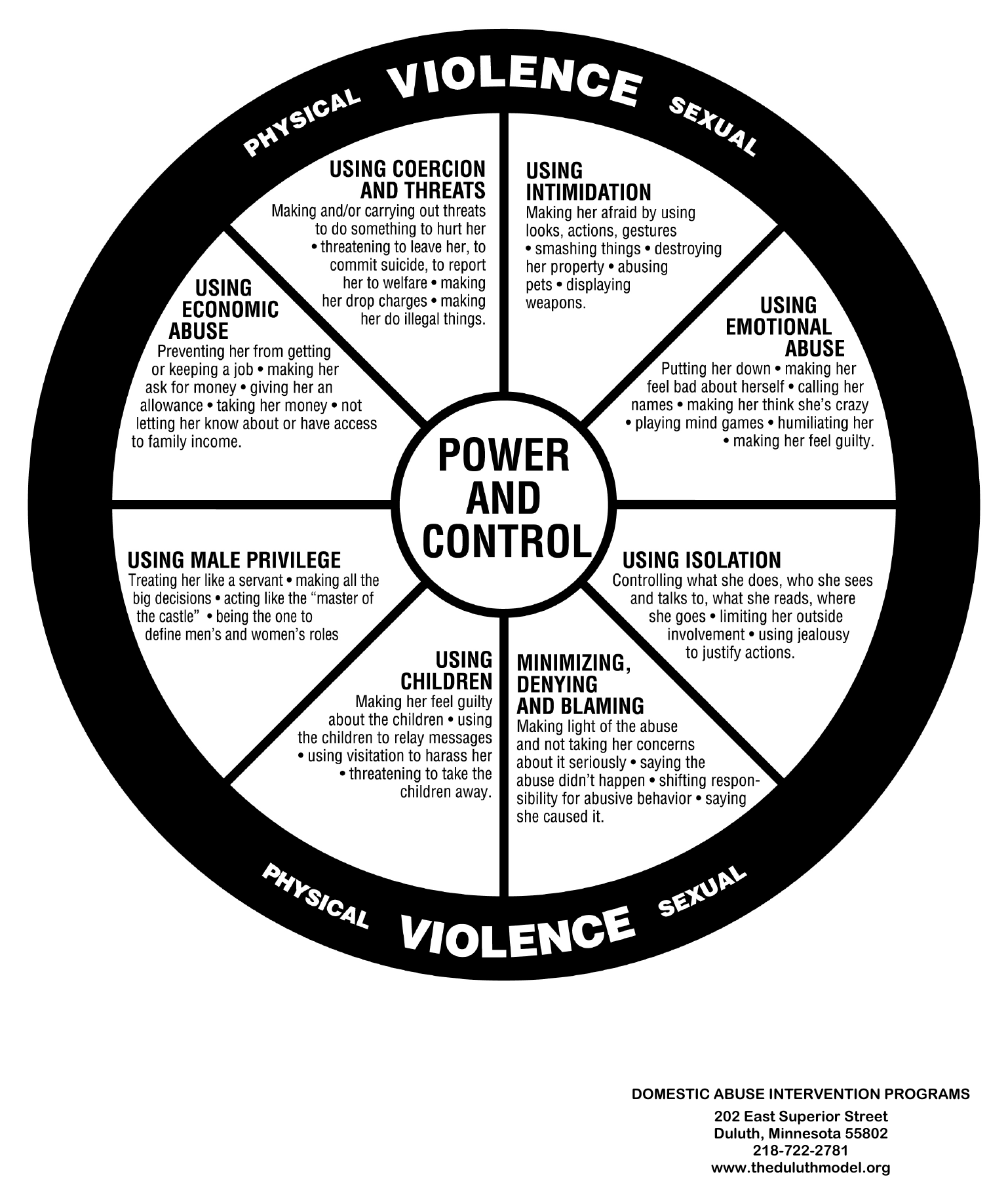
Power and Control Wheel: Domestic Abuse Intervention Programs, 202 East Superior Street, Duluth, MN 55802 · theduluthmodel.org
The diagram uses “she” for the person being hurt and “he” for the person doing the hurting. The behaviours happen to people of any gender, in any kind of relationship.
Resources
If some of this sounds like your relationship, you can call and talk it through without deciding anything: (605) 665-1448.
Waypost — (605) 665-1448, any hour.
Teen Dating Violence
Dating should be about respect, trust, and care. For a lot of people it isn’t — there’s control, or there’s abuse.
Some of the signs look small. They usually don’t stay small.
If something in your relationship doesn’t feel right, talk to someone about it. You don’t need proof and you don’t need to know what to call it.
What a good relationship looks like
- You can say hard things to each other
- What the other person feels and needs matters to you, and yours matters to them
- You’re both glad about each other’s friends, school, work, and interests
- No means no, every time, from both of you
- You build each other up
- You listen
- You meet in the middle
- You each get space
And respect yourself in it too.
Warning signs
OneLove has a plain list of ten signs a relationship isn’t healthy, with an explanation of each.
Resources
You can call us, and you don’t have to give your name: (605) 665-1448.
OneLove — Read the ten signs on OneLove
Waypost — (605) 665-1448, any hour.
Sexual Assault
Sexual assault is any unwanted sexual contact or behaviour. That covers rape, harassment, being exploited, being trafficked, and having images of you shared without your say-so.
It happens to people of any age, gender, or background. Most of the time, the person who does it is someone the survivor knows.
It’s not your fault
Not what you wore. Not what you drank. Not where you went, who you went with, or what you said before. Not that you didn’t fight, or didn’t leave, or waited to tell someone.
What we can do
- Come to the hospital with you
- Talk through whether to report, and go with you if you do
- Go to court with you
- Counseling and support group
- Just answer the phone at 3am
Resources
Waypost — (605) 665-1448, any hour.
National Sexual Assault Hotline (RAINN) — 1-800-656-4673.
After an Assault
You may have gotten a lot of information at the hospital and not remember much of it. That’s normal. Here’s the short version, and our number if you’d rather just talk to a person: (605) 665-1448, any hour.
Nothing here is something you have to do
Reporting is your call. So is a medical exam, an order, and telling anyone. You can do one and not the others, or none, and still get help from us.
Your health
If you’re hurt, or something doesn’t feel right, call your doctor or go back to the hospital that saw you. You don’t need a reason beyond wanting to be checked.
If you were given medication and it’s making you feel bad, call the doctor who prescribed it before you stop taking it.
If you have questions you’d rather not ask a stranger, an advocate can sit with you while you make the call, or make it with you.
If you reported it
The State’s Attorney is the lawyer for the state. They don’t cost you anything, and they’re not your personal lawyer.
An officer will ask you a lot of questions — where you were, how you know the person, what was said, what you did after, who you told. Some of it is hard to answer.
Not remembering something is normal. It doesn’t mean the case is over and it doesn’t mean anyone thinks you’re lying.
An advocate can be with you for any of it.
If it goes to court
The State’s Attorney will go over what happened before you testify. In court they’ll ask you about it, and then the other lawyer will ask you questions too. It’s usually the same ground the officer covered.
A lot of cases don’t reach a trial — someone pleads guilty, there’s a plea agreement, or there isn’t enough evidence. That’s not a verdict on you.
How you might feel
There’s no normal way to feel after this, and there’s no schedule.
Some people feel numb, or unsure who to tell. Some feel ashamed, or afraid it’ll happen again, or angry at everyone. Some can’t stop showering. Some blame themselves for what they did or didn’t do. Some feel like they have no say over anything. Some don’t want to be alone. Some don’t want to be touched, and worry that won’t change.
None of that means something is wrong with you. All of it is worth saying out loud to someone.
Resources
Call (605) 665-1448, any hour. An advocate can go with you to the hospital, to the police, or to court — or just talk.
Waypost — (605) 665-1448, any hour.
Stalking
Stalking is a pattern of behaviour aimed at one person that would make a reasonable person afraid or badly distressed.
Fear is personal, so stalking is too. A lot of what a stalker does looks like nothing from the outside and is terrifying if you know the context.
Most people are stalked by someone they know — often a partner or an ex, someone who knows exactly what you’re afraid of.
What it looks like
Calls, texts, emails, and messages you didn’t want. Showing up. Watching. Following. Gifts. Rumours. Damage to your things. Threats — to you or to people you love.
Two incidents can be a pattern, and the laws differ by state. Some of it isn’t a crime on its own. The pattern is still real.
One practical thing
Write it down. Every time. Date, time, what happened, screenshots. It feels pointless and it’s the single most useful thing you can do if you ever want an order or a case.
Fear can look like other things
People being stalked often don’t look afraid. They look annoyed, or they play it down. Avoiding places, screening calls, changing your route — that’s fear too.
Resources
South Dakota has a stalking protection order, and an advocate can help you apply. Call (605) 665-4811 during office hours, or (605) 665-1448 any time.
Waypost office — (605) 665-4811, office hours.
Waypost — (605) 665-1448, any time.
Human Trafficking
Trafficking is when someone uses force, lies, or pressure to make another person work, or perform sex acts, for someone else’s profit.
It happens to people of every background. It happens in small towns. It happens in South Dakota.
Three things people believe that aren’t true
“It only happens in cities.” It happens in rural places too — often more easily, because there are fewer people watching and fewer places to go for help.
“Traffickers are strangers.” Most of the time they aren’t. They get to know the person first. Sometimes they’re a partner, a spouse, or a parent.
“Someone has to be moved somewhere.” No. People are trafficked in their own town, in their own house.
Why someone stays
It’s hard to leave any situation where someone else has control. The reasons are different for everyone — money, debt, fear, or not being ready to call it what it is.
Traffickers make leaving feel impossible. They say no one will believe you. They say you’re the one who’ll get in trouble. They ask who’ll pay your rent, who’ll love you.
Leaving is the most dangerous moment. If you know someone in this, help them get to the resources. Let them pick when.
Resources
National Human Trafficking Hotline — 1-888-373-7888, or text HELP to 233733. Confidential, any hour.
Waypost — (605) 665-1448.
Child Abuse
Child abuse is something a parent or caregiver does — or fails to do — that hurts a child, or puts a child in danger of being hurt.
That includes serious injury, sexual abuse, neglect, and being left in a situation where harm is likely.
Hard things that happen in childhood can affect a person’s health and life for years afterward.
Reporting
Anyone can report a concern about a child. You don’t have to be certain and you don’t have to be a professional.
Resources
Childhelp — 1-800-422-4453. Any hour, anonymous, 170 languages.
Waypost — (605) 665-1448.